

The work between an idea and a paying customer
Market research, assumption tests with the thresholds set in advance, a waitlist on your own domain, a two-variant test, and a build spec a developer can start from on day one. Twenty agents do the work. You make the calls, and every one of them sits next to the evidence it was made on.
Seven stages, and what has to be true to leave each one
Start at whichever stage you're actually at; the team fills in what you already know. A stage closes on evidence rather than a feeling of being finished, and the project page always shows the next step.
| Stage | What the team produces | Exit condition |
|---|---|---|
| ResearchResearch Lead | Market map, competitor table, who the customer is and what they use today | A research brief you've read |
| ValidateQA & Validator | Assumptions ranked by risk, each with a test, a pass line and a fail line; a log of customer conversations | The riskiest test has a real result, or you moved on and recorded why |
| Build specProduct Lead | A one-page brief, then nine supporting documents | The brief is written and approved |
| PrototypeProduct Lead | A clickable mock-up built from the screens document | Something you can put in front of people |
| MarketingMarketing Lead | Brand kit, positioning, a waitlist page, a first campaign | Material in place and a campaign running |
| BuildEngineering Lead | The spec handed to a developer or a builder tool, or run with your agents first | A live address added to the project |
| LaunchMarketing and Customer Lead | Leads in, follow-ups drafted, retention watched | Customers you can name |
Moving on without a result is allowed. The project is marked untested from then on, so nobody forgets.
Tests are set up to fail before they're run
Thresholds written before the data comes in
The QA & Validator agent breaks the idea into the assumptions it depends on and ranks them by how badly the business fails if each one is wrong. Every assumption gets a test and both thresholds up front, so a weak result can't be read as encouraging after the fact.
Customer conversations are logged on what people have actually done: the last time the problem happened, what it cost them, and whether they committed to anything. Opinions about a product that doesn't exist yet don't count.
- Assumption orderriskiest first
- Each test carriesmethod · pass · fail
- Mark validatedlocked until the riskiest has a result
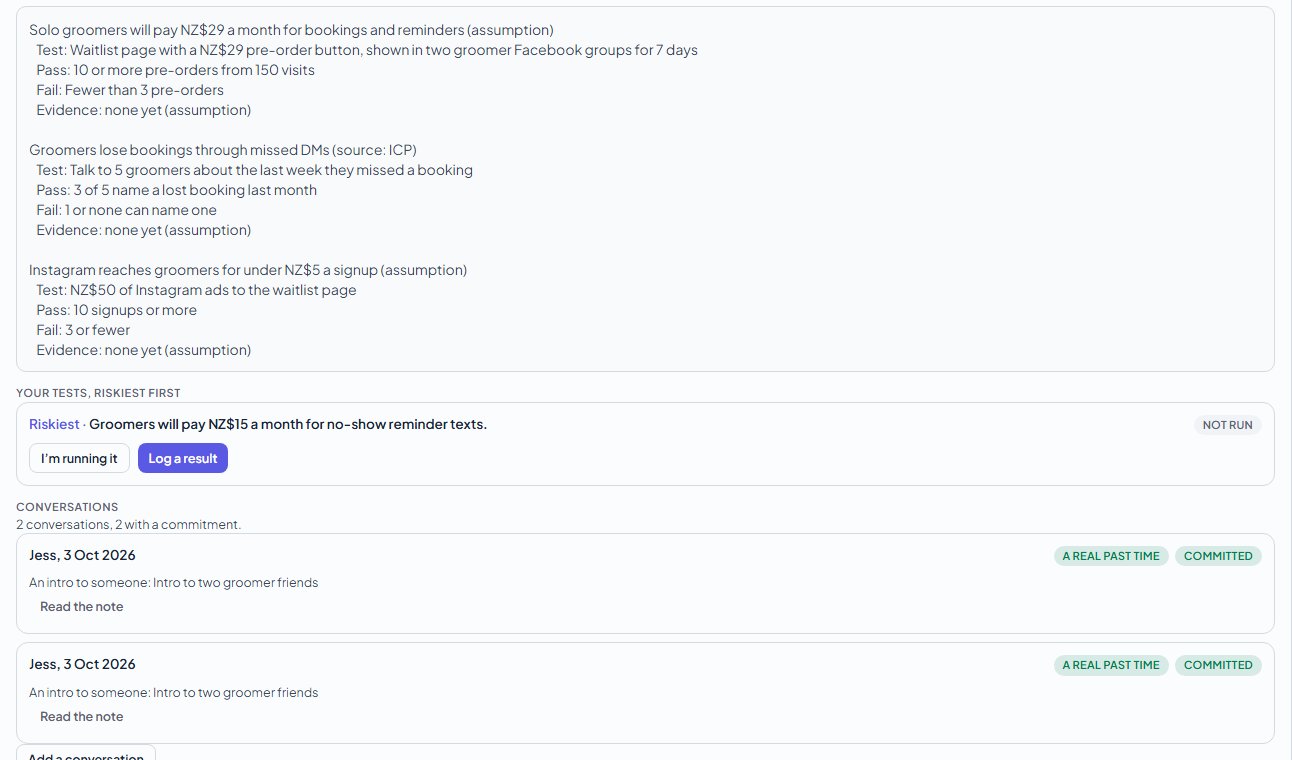
A test project for solo pet groomers.
A waitlist and a split test that count themselves
The Marketing Lead writes the page from the validation, in the words customers used. It exports as a single HTML file for your own domain, with tracking built in, and every signup lands back in Volt26 as a lead.
Two framings run side by side on tagged links. Visits and joins are counted per variant, and the verdict stays closed until each has had 100 visitors, so a lucky first afternoon doesn't decide your positioning.
- Hostingyour domain, one file
- Attributionutm_campaign · utm_content
- Minimum sample100 visitors per variant
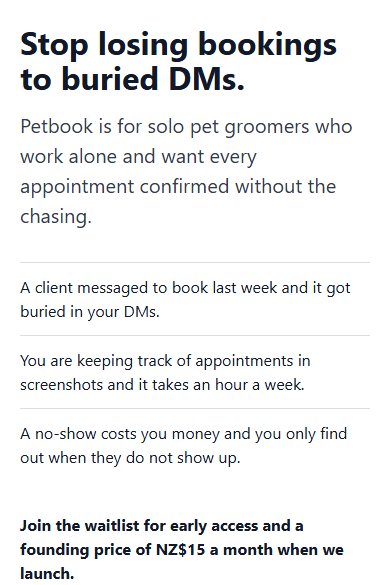
Exported page, on a phone.
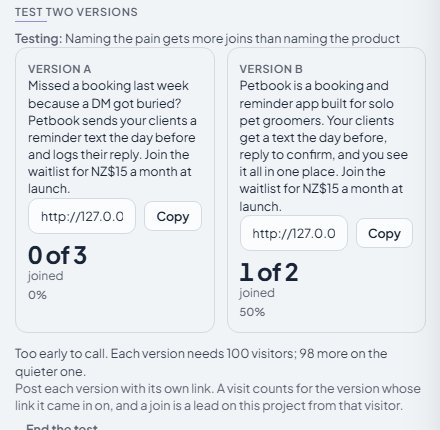
Too early to call, by design.
A specification, written before anyone opens an editor
The brief comes first: what you're building, for whom, what ships first and what is deliberately out of scope, with each line traced to the research or validation it came from. Nine documents follow, written the way a product team would before an engineer starts.
- Productroles and stories · screens and flows
- Engineeringdata model · integrations · rules and privacy
- Go to marketdesign and copy · analytics plan
- Deliverybuild plan and tests · builder prompts
Hand it to a developer, or to Lovable, Bolt, Replit or Claude Code with the prompts already cut to size.
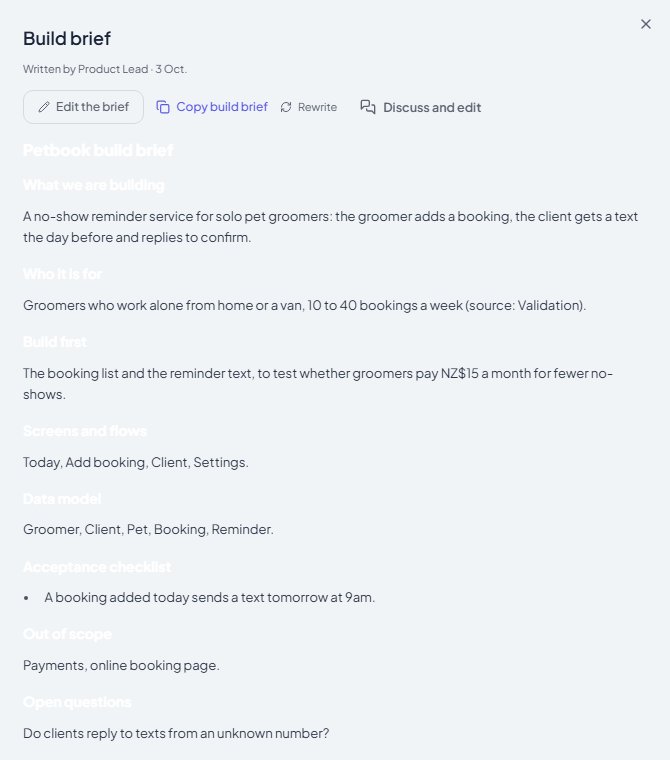
The brief, citing the validation it came from.
The team does the work, and the decisions stay with you
Everything outward waits for your Authorize, everything is logged, and three of the agents are there specifically to disagree with you.
Research, drafts, analysis
The runs that would take a week of evenings: the market map, the test design, the page copy, the spec. They keep going overnight if you leave them to it.
Challenge, not applause
The Contrarian, Exit Lens and Simplicity Enforcer read the plan and say where it's weakest before you put money into it.
Every call that matters
Pass or fail, pivot or continue, publish or park. A pivot keeps the evidence and points the project somewhere new.
Start at the stage you're at.
Founder is US$149 a month, with all twenty agents. 14 days free, no card to start.